Political security risk
Using FPTP with multiple parties means that a constituency MP win can occur with a very low vote share, a good example is 2015 in Belfast South, where they take politics very seriously, with the following % vote shares:
SDLP 24.5, DUP 22.2, Alliance 17.2, Sinn Féin 13.9, UUP 9.1, Green (NI) 5.7, UKIP 4.9, NI Con 1.5, Workers' P'ty 0.9
1992 Inverness, Nairn and South gives another example: LibDem 26.0, Lab 25.1, SNP 24.7, Con 22.6, Green 1.5
And 2024 gives many examples e.g. West Norfolk 26.7% (1 of 10 MPs wit between 26.7% to 28.5%) and many more low vote wins are shown on the pie chart in "Introduction and Content Map - 2024 MP votes in bands" e.g. 39.4% of MPs were elected with between 30% to 40% vote share.
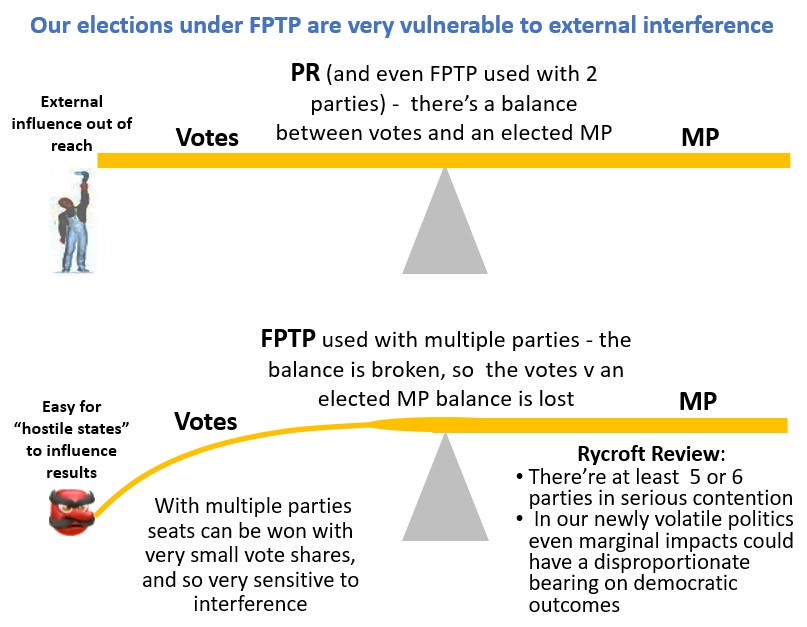
The above figures shows that FPTP and simple “winner-takes-all” has in these cases not represented the general wishes of voters, and the elected MP represents just narrow number of voter wishes, although of course they promise to represent all constituents however they voted, if at all. This is simply because FPTP is not designed to do otherwise – it’s a 2 party voting system and the wrong one in these circumstances. This has been the case for a long time and particularly in fragmented constituencies (just for balance a non-fragmented very safe-seat is Liverpool Walton e.g. 2017 Lab 85.7, Con 8.6, Independent, LibDem, Green 5.6), but as our political landscape broadens and the number of parties in serious contention is now 5 or 6 (as Rycroft Review March 2026) the number of fragmented constituencies increases and so many more seats can be won on low vote shares. But not only are these democratically un-representative it makes wining very sensitive to media involvement and money, and from external actors wanting to influence or politics – so not only un-democratic but a political security risk.
The above diagram tries to show this graphically, where with FPTP the balance between votes and elected MP bends under the quantity of choice, and to such an extent as to become within the reach of those wanting to influence the outcome by media influences on suitable voters. This is unlike PR style systems that maintain a firm balance between votes and elected MP and so keep the interference out of the reach of malicious actors.
(AI ) “The 2026 Rycroft Review identified significant risks of foreign interference in UK elections, specifically finding that both money and media are actively used to exploit vulnerabilities”. The Representation of the People Bill 2026 is planning actions to reduce these risks, which is obviously good news, but the core activity should be to replace our current voting system that is so sensitive to manipulation and makes it vulnerable to foreign interference – we need a secure proportional voting system that is appropriate to our multi party political environment.
Why US National Security Strategy failed in Hungary

The US National Security Strategy (Nov. 2025) includes the support of right-wing European and UK parties, as in this image of Orbán and Vance in Budapest on 7 April 2026 - see "History and Other links" for more on US National Security Strategy. However, Orbán didn't win, despite Vance's intervention that didn't appeared to help much; one reason given is few knew who Vance was. But another is Hungury's voting system where the 199 members of the National Assembly were elected by mixed-member majoritarian representation; 106 were elected in single-member constituencies by first-past-the-post voting, while the other 93 were elected from nationwide party lists by modified proportional representation (Wikipedia). The FPTP element of the system was a 2 horse race between Tisza 54% and Fidesz-KDNP Party Alliance 38% vote shares, and so FPTP was not an unresonable system in this case.
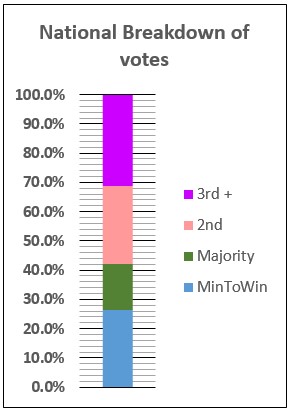
"Analysis - How it happens" shows that many votes in our FPTP system are irrelevant to any result, for example this breakdown of 2024 National vote, but it’s not the case in Hungary. The party list element of Hungary's system, which elected the 93 National Assembly members, is based on a second vote (in this election also a similar 2 horse race), but Loser and Winner Compensation votes from the FPTP element are also added to the appropriate Party-List tallies; considering our example it would be all those other than the MintoWin, where Majority votes would be processed as Winner Compensation and 3rd+ and 2nd as Loser Compensation. However, this arrangement is contentious and an AI comment is: "In practice, the "winner's bonus" often outweighs the "loser's help." In the 2014 election, winner compensation alone handed the ruling party roughly six extra seats they wouldn't have otherwise had." But is this more or less fair than us totally disregarding these otherwise irrelevant votes? - notwithstanding my comments about 2nd place votes providing a useful pass mark for the winner.
So I would suggest that Hungary’s more robust and secure electoral system, for any faults that it may have, at least isolated them from US intervention – a protection that we do not enjoy.