No longer fit for purpose - Why it fails
It was the question "How many PMs since WW2 have been elected with an overall majority of the vote?" that initiated this section of why we have such illogical results, and the not totally unexpected answer of zero. But Anthony Eden came close in 1955 with his Conservatives getting 49.7% of the vote – Labour got 45.4% and together Liberals and Sinn Féin 3.3%. And Eden became PM with a respectable 60 seat majority. Other parties stood, but not in many of the 630 constituencies, the Liberals in 110 and Sinn Féin not surprisingly stood in just 12. Therefore the vast majority of ballot papers only offered Conservative or Labour, making it a 2 horse race and within FPTP’s capabilities. But as you can see below, things changed over time and ballot papers offered more and more parries, and so way beyond FPTP’s capabilities.
The following table is an extended version (below dotted line) of the Challenge Actual Results, but going back to 1955 and showing a Political Landscape in the form of some Wikipedia General Election results in summary form. Even if you don’t read the detail of the Wiki summaries you can see that it gets steadily more complex over the years. A full explanation follows below the table.
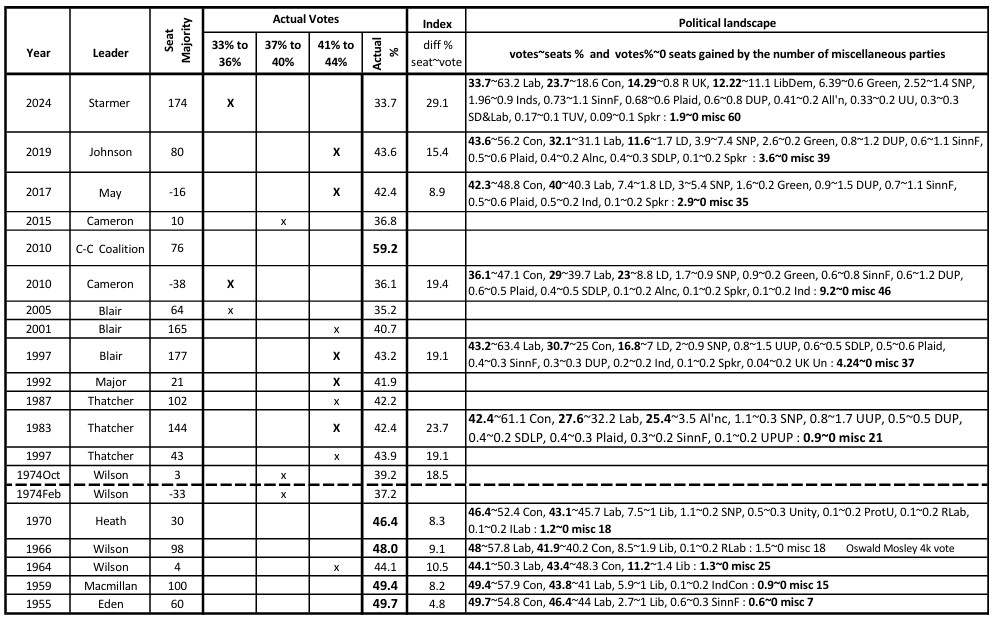
The new column “Index diff % seat~vote” shows a Gallagher style index (see Measuring Failure) of mismatch between % of seats and votes (it’s the sum of the difference of each party, divided by 2 e.g 2024: Lab difference 33.7~63.2 is 29.5 [ignore the sign], do this for all parties and add together, divide by 2 = 29.1). The information in Political Landscape is taken from Wikipedia General Election results and given here in a long string of %vote~%seats including the party name, and at the end the %votes that didn’t result in any seats with the number of “miscellaneous” parties involved.
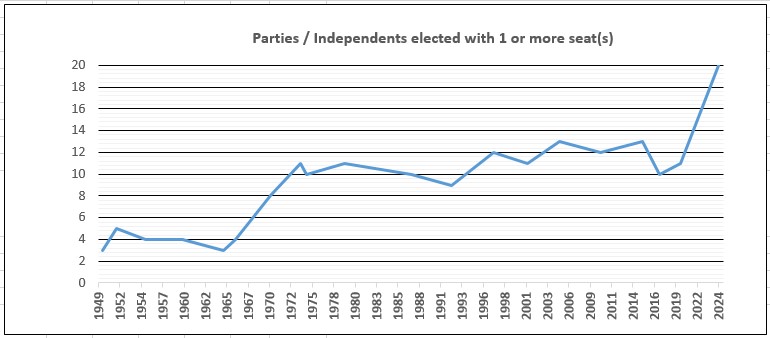
The string of results is the totality of parties on offer for each GE and of course each constituency offered just some of them. Only a sample of GEs are shown, but the trend is from a very narrow field of parties in 1955 to 2024 where 14 parties gained seats, plus some Independents and more than 59 parties / independents got votes but no seats, although it’s common practise to ignore low vote share parties.
Although 1955 was a 2 horse race and something FPTP can cope with, it still gave a mismatch between the percent of seats won against votes obtained, with Eden getting 54.8% of the seats for 49.7% of votes. But this is an inherent problem with FPTP, even with just 2 parties.
The Actual % Vote Share includes 2 elements of inactive votes:
- To win a seat all you need is 1 more vote than the other party, however big majorities (or if more than 2 parties involved it’s often a “margin of victory” e.g Hendon and hover / click “Majority” by the 15 ) are often praise, but an MP is still only 1 lobby vote – its election overkill and inactive votes.
- Votes cast in constituencies where the party doesn’t win.
Both the above influence the vote share, but not necessarily the number of seats won (as confirmed by Excel FPTP simulator), and of course it gets considerable worse when several parties are involved, as can be seen above - for more detail see Analysis - How it happens.