Introduction and Content Map
Introduction
This is a collection of information highlighting the failings of First Past The Post electoral system when used with more than two parties. As we again more parties, FPTP becomes increasingly unstable and more susceptible to the political environment rather than numbers of votes; it then produces unpredictable results that are increasingly unrepresentative of votes cast.
Continued use of FPTP in our modern multi-party country threatens the UK’s democracy, especially considering recent US National Security Strategy objectives and acknowledgement that our political donation rules need updating.
I suggest there are 3 groups involved in our democracy:
- The government, and other political parties, who often appear to have more interest in maintaining their own power than the interests of the country
- The media who again some of whom have more interest in maintaining their power and influence rather than presenting true and factual news.
- The voting public who are groomed by the above 2 and have been encouraged to believe that FPTP is a system that quickly provides strong and stable government, and stops the endless debate that Europeans have in order to form and run governments. At best some of the electorate try to work round the inadequacies of FPTP with tactical voting, but as Emma Harrison (Chief Executive of Make Votes Matter) says: "It’s not a positive expression of belief or hope — it’s damage limitation. And tactical voting isn’t a clever workaround; it’s a symptom of a broken system.".
Summary conclusions - the political environment, often established by media interests and then followed by governments has two major effects on FPTP as we are using it.
- The Vote Share of the winning party stays relatively constant from election to election, but the environment determines the winning party’s level of power in terms of Seat Share.
- The diversity of the political environment creates fragmentation and increases the number of viable constituency candidates, which in turn has a big impact on FPTP and can enable "winning and taking all" to occur very easily on a small number of votes.
This may not be a great surprise, but hopefully the information here will confirm popular ideas and put some figures on them. And of course other voting systems are susceptible to media and political environments, but according to AI for one alternative - “the STV system is generally considered less susceptible to the influence of party media promotion than the FPTP system. This reduced susceptibility stems from the fundamental differences in how the two systems function and influence voter behaviour” - and continues with more detail.
A link to the US National Security Strategy published on 4 December 2025, plus two quotes from it, are included in History and Other links. The strategy makes it clear that the US intends to encourage right wing governments in Europe and the UK. At the same time Kier Starmer is authorising an "urgent" review into foreign interference in British politics, and is preparing to change the law to tighten donation rules. As already said, FPTP and its results are very susceptible to political environment manipulation and is a gift to the US strategy and money. Our elections are currently hackable in the same way as an unprotected computer system. We need to make them more secure with an appropriate voting system.
Changing from FPTP is not an option, it is esential for national security.
Above Content Map image
The central section offers a number of topics and a Challenge activity – tap / click to select. The surrounding “collage" and top of page banner is a reminder that we are using a 2 party voting system for multiple parties as follows:
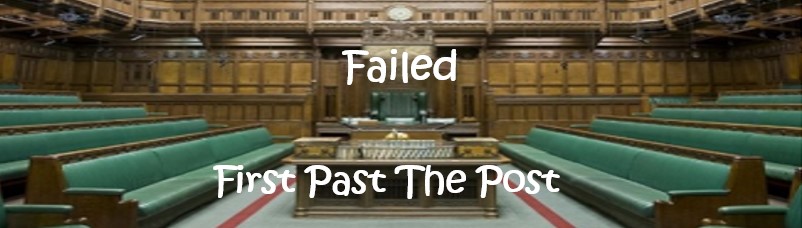
- The ancient House of Commons Chamber has two confronting rows of benches, with a row provided for each of the two parties and “designed to facilitate the British Parliament's adversarial system of debate - AI”. If only - leave this as a tourist attraction and use a modern circular multi-party style chamber.
- The gaming table is a hint to our elections being a game of chance / winner takes all as discussed in the Challenge Quiz.
- This is Our Hemisphere - the US actions in Venezuela (Jan 26) shows the US National Security Strategy in action. The strategy includes the unilaterally declared 1823 Monroe Doctrine and the support for right-wing governments. FPTP makes our elections very susceptible to interference.
- The selection of ballot papers - one representing 1950 (when FPTP was appropriate) showing just two candidates and contrasting a 2024 example with 10 candidates.
- The row of 5 candidates waiting for the returning officer to announce the winner. This is part of the discussion about misuse of the term Majority used on these occasions, as discussed in When is a Majority not a Majority
- Some may also remember the race image as used in the 2011 referendum campaign against introducing proportional representation (although many pointed out that AV is not PR) - interestingly David Davis was First Past the winning Post, so why did we get Cameron as the PM?